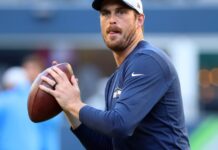
It’s been just over a week since Christian Parker was hired to run the Cowboys defense, and the 34-year old is busy building his defensive coaching staff. The biggest name that’s been connected to the Cowboys so far is Zach Orr, a 33-year old coach who just spent the past two seasons running the Ravens defense.
Orr also interviewed for the defensive coordinator job in Dallas, and it seems Parker is keying in on him for an elevated role with the Cowboys. While there would certainly be some value added with Orr in the building, there are also some questions that need answering before we can call this one a home run.
Orr comes with elite experience
The DeSoto, Texas native played linebacker for three years in Baltimore after going undrafted out of North Texas. After starting out as a core special teamer, Orr became the Ravens’ starting WILL linebacker in 2016, his third season. He finished with 133 tackles, three picks, and two fumble recoveries, and was named Second Team All-Pro.
Unfortunately, his season was cut short with a neck injury. After later testing, he was forced to retire with a congenital neck/spine issue. A second opinion later in the offseason saw Orr try to make a comeback, but no team was willing to take a chance with such a serious injury.
With the love of the game still burning inside him, Orr transitioned to coaching, starting out as an analyst with the Ravens. After four years in that role, he followed defensive line coach Joe Cullen to Urban Meyer’s staff in Jacksonville; Cullen was the defensive coordinator, and Orr was the outside linebackers coach. Brian Schottenheimer, notably, was the quarterbacks coach and pass game coordinator.
They were all out of a job one year later, of course, and Orr returned to Baltimore to coach the Ravens inside linebackers. When Mike Macdonald was hired as the Seahawks head coach, Orr was promoted to replace him as the defensive coordinator.
Therein lies the reason for such excitement around Orr. For the past two decades, the Ravens organization has been a hub for defensive creativity and innovation. Don “Wink” Martindale overhauled their scheme when he was promoted to coordinator ahead of the 2018 season. His aggressive and complex hybrid scheme favored blitzes early and often.
Macdonald came up under him and, after one year leading the Michigan Wolverines defense, he returned to replace Martindale. His tenure was widely praised, even more so than Martindale, because of the way he streamlined decades of defensive language within the organization into its most digestible form. Macdonald was then able to take the best parts of a long list of very successful Ravens defensive coordinators and mold it all together into one of the most potent and creative defensive schemes in the league.
Orr was front and center for it all. His rookie year came with Martindale coaching his position group, and Macdonald had just been promoted from intern to defensive assistant. Orr’s second season as a coach saw Martindale rise to the coordinator role, and Orr studied directly under Macdonald for two years before being promoted.
So many teams have tried to pick branches off the Ravens defensive coaching tree over the years – Schottenheimer worked closely with one, Rex Ryan, for several years with the Jets – and getting Orr in the building taps directly into that pipeline. He was there for three different coordinators as a player and coach, and then ran the defense himself, all before turning 33.
That kind of experience is hard to find at such a young age.
Questions remain unanswered, though
Orr was front and center for all that innovation and creativity, yes. It’s a big reason why John Harbaugh promoted him to replace Macdonald over other, more tenured names like Dennard Wilson and Anthony Weaver. But one would think that all that experience would make Orr an instant success.
That was far from the case.
Macdonald’s first year running the defense saw them finish 11th in EPA/play. The next year, they improved to second. Their pass defense led the way both years, being especially effective against downfield passing attacks.
Orr’s first year also saw the team finish 11th in EPA/play, though it was quite the decline given he retained nearly all of the starters from the previous season. Then, this past year, Baltimore fell to 18th in EPA/play; it was only the second time in the Harbaugh era that the Ravens were in the bottom half of the league in per-play efficiency.
So what went wrong?
Many in Baltimore pointed to poor situational play-calling for Orr. With an anemic pass rush this season – Baltimore was 29th in pressure rate – Orr was at a loss for ways to scheme up pressures. He was using stunts about as much as Macdonald had, but Orr only blitzed on 23.4% of dropbacks; that’s less than Matt Eberflus blitzed quarterbacks.
Orr would also frequently ask his defensive backs to play back on third and long, giving up too much cushion and allowing for easier completions. In fact, on just third down this year, Baltimore gave up the third-most passing yards per game.
Of course, the one area where Orr’s defense shined was against the run. The former run-stopping linebacker clearly knew what he was doing in that regard, as the Ravens were among the six best teams in EPA/rush each of his two years as the coordinator.
However, Orr’s defense also had a lack of exposure to the run. This year, they saw the eighth-fewest rushing attempts of any team; last year, the second-fewest. Were the Ravens stout against the run because their scheme and execution, or did they benefit from a small sample size because teams knew they could throw it all over the field? It’s a chicken or the egg scenario, but one that deserves analysis.
Reports seem to indicate that Orr would join Dallas in some form of a run game coordinator, and on the surface this makes sense. It would also be helpful for Parker to not only have a former coordinator on his staff, but specifically someone who stepped into that role at such a young age, similar to what Parker is going through now.
It’s fair to wonder, though, how much Orr actually brings in terms of X’s and O’s. And while some have floated the idea of Orr being an eventual replacement for Parker if/when Parker gets a head coaching opportunity, what confidence can one have that Orr would be able to successfully succeed Parker after he ultimately failed to succeed Macdonald?
None of this is to say that the Cowboys shouldn’t hire Orr. He brings plenty of value to the staff, without question, and if Parker wants him, he should have him. But there are serious questions that need to be asked and answered based on Orr’s resume.