The breakup of C/2025 K1 (ATLAS), captured by the NASA/ESA Hubble Space Telescope, opens a window into how fragile comet nuclei evolve and collapse.
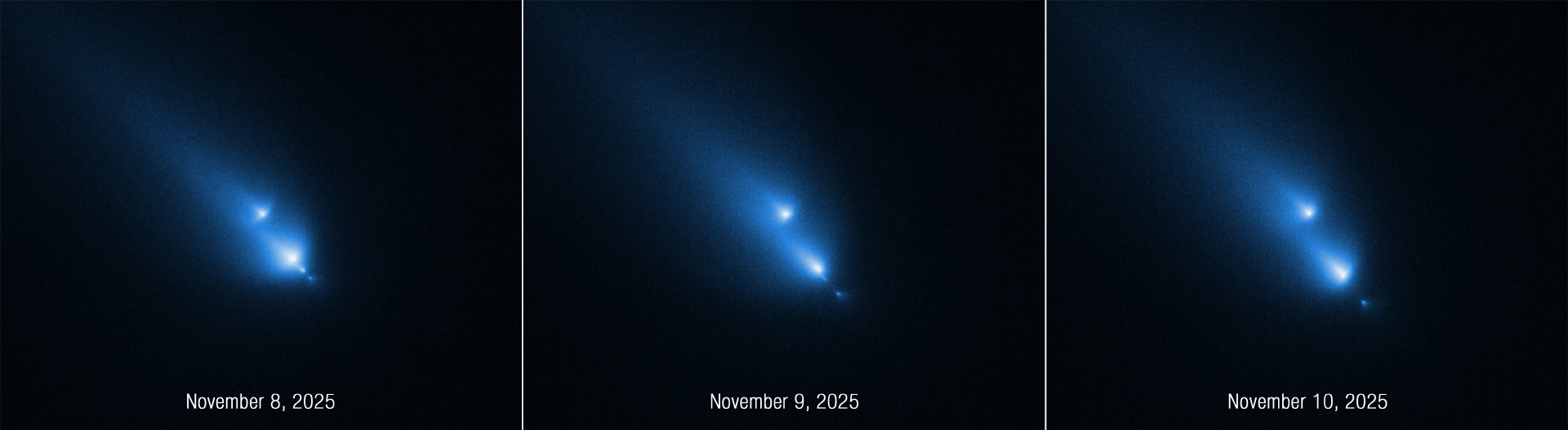
These Hubble images of the fragmenting comet C/2025 K1 (ATLAS) were taken over the course of three consecutive days: November 8, 9, and 10, 2025. Image credit: NASA / ESA / D. Bodewits, Auburn / J. DePasquale, STScI.
“Sometimes the best science happens by accident,” said Auburn University’s Professor John Noonan, co-author of the study.
“This comet got observed because our original comet was not viewable due to some new technical constraints after we won our proposal.”
“We had to find a new target — and right when we observed it, it happened to break apart, which is the slimmest of slim chances.”
C/2025 K1 (ATLAS) reached perihelion — its closest approach to the Sun — at 0.33 AU on October 8, 2025.
The event was inside Mercury’s orbit, about one-third the distance of the Earth from the Sun. During perihelion, a comet experiences its most intense heating and maximum stress.
Hubble images obtained on November 8-10, 2025 resolved five fragments, providing an early high-resolution view of a cometary nucleus in the process of disruption.
“Never before has Hubble caught a fragmenting comet this close to when it actually fell apart,” Professor Noonan said.
“Most of the time, it’s a few weeks to a month later. And in this case, we were able to see it just days after.”
“This is telling us something very important about the physics of what’s happening at the comet’s surface.”
“We may be seeing the timescale it takes to form a substantial dust layer that can then be ejected by the gas.”
C/2025 K1 (ATLAS) is now a collection of fragments about 400 million km from Earth.
Located in the constellation of Pisces, it is heading out of the Solar System, not likely to ever return.
Astronomers see that long-period comets such as C/2025 K1 (ATLAS) are more likely to fragment than their short-period cousins, such as 67P/Churyumov-Gerasimenko that was visited by ESA’s Rosetta mission, but it is not known why.
Launching towards the end of the decade, ESA’s Comet Interceptor will be the first mission to visit a long-period comet.
“Hubble’s chance observation of C/2025 K1 (ATLAS) will help us understand why some long-period comets split apart and give us a first view of their interiors,” said University of Edinburgh’s Professor Colin Snodgrass.
“These new results will complement the detailed view of a long-period comet that we will obtain from Comet Interceptor, as well as helping astronomers to select the mission’s target.”
The study was published on February 6, 2026 in the journal Icarus.
_____
D. Bodewits et al. Sequential fragmentation of C/2025 K1 (ATLAS) after its near-Sun passage. Icarus, published online February 6, 2026; doi: 10.1016/j.icarus.2026.116996